Global EbA Fund Medium-Size Grants 2026: Apply for Up to $500,000 in International Environmental Funding
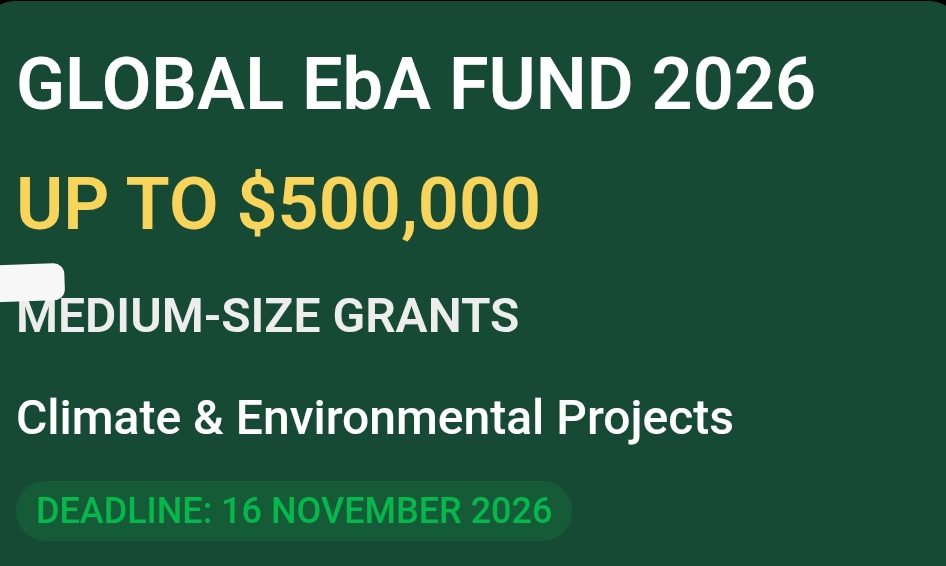
Are you an NGO, environmental organisation, research institution, or university working to address climate change and protect natural ecosystems? The Global EbA Fund Medium-Size Grants 2026 could provide an opportunity to secure up to US$500,000 to advance your environmental and climate adaptation initiatives.
The Global EbA Fund has opened its first Medium-Size Grants Call for Proposals, inviting organisations worldwide to develop innovative projects that help communities adapt to climate change through the protection, restoration, and sustainable management of ecosystems.
The funding programme is particularly interested in initiatives that strengthen environmental policies, improve climate adaptation financing, promote biodiversity conservation, and create opportunities to scale up Ecosystem-based Adaptation (EbA).
Successful projects can receive grants of up to US$500,000 and run for a maximum of 24 months.
The application window opened on 12 October 2026 and closes on 16 November 2026.
This guide explains how the Global EbA Fund works, who can apply, what projects are eligible, the documents required, how applications are evaluated, and how interested organisations can submit their proposals.
Global EbA Fund Medium-Size Grants 2026: Key Information
Before preparing an application, here is a quick overview of the opportunity.
| Grant information | Details |
|---|---|
| Funding programme | Global EbA Fund |
| Opportunity | Medium-Size Grants 2026 |
| Funding type | International project grant |
| Maximum funding | US$500,000 per project |
| Project duration | Up to 24 months |
| Application opening | 12 October 2026 |
| Application deadline | 16 November 2026 |
| Eligible applicants | NGOs, INGOs, IGOs, CBOs, universities, research institutions, think tanks, eligible companies and consortia |
| Geographic eligibility | Global, thematic or ODA-eligible countries |
| Application language | English |
| Application method | Online |
| Official application portal | IUCN Grants Management System |
Important: The US$500,000 is the maximum grant amount, not a guaranteed award for every applicant. All proposals are subject to eligibility checks and competitive evaluation.
What Is the Global EbA Fund?
The Global EbA Fund is an international funding mechanism designed to accelerate the adoption and expansion of Ecosystem-based Adaptation.
It is implemented by the International Union for Conservation of Nature (IUCN) and the United Nations Environment Programme (UNEP), with support from Germany’s International Climate Initiative (IKI).
The Fund addresses barriers that prevent nature-based solutions from being widely adopted as effective responses to climate change.
These barriers may include limited institutional capacity, insufficient environmental research, weak policy frameworks, inadequate financing, and a lack of coordination between organisations working on climate and biodiversity issues.
Through its grants, the Fund supports innovative initiatives that can help overcome these challenges.
Its broader objective is to ensure that ecosystem-based approaches become an important part of climate adaptation planning, environmental investment, and sustainable development.
The 2026 funding announcement introduced two grant opportunities: Small-Size Grants and Medium-Size Grants.
The Medium-Size Grants are designed to support larger catalytic initiatives with the potential to influence environmental policies, financing systems, institutional capacity, and the wider implementation of EbA.
What Is Ecosystem-based Adaptation (EbA)?
Ecosystem-based Adaptation is an approach that uses biodiversity and ecosystem services to help people adapt to the negative effects of climate change.
It involves conserving, restoring, and sustainably managing ecosystems to reduce climate-related risks and strengthen the resilience of communities.
Rather than relying exclusively on infrastructure or technological interventions, EbA recognises that healthy natural ecosystems provide important protection against environmental challenges.
Examples include:
- Restoring mangrove forests to protect coastal communities against erosion and storm impacts.
- Conserving wetlands to reduce flooding and improve water management.
- Restoring forests to protect watersheds and improve water security.
- Promoting sustainable agriculture to help farmers adapt to changing weather patterns.
- Protecting grasslands to reduce land degradation.
- Restoring coastal ecosystems to strengthen climate resilience.
- Conserving biodiversity to maintain essential ecosystem services.
For example, a project in a flood-prone community could combine wetland restoration, local environmental planning, scientific research, and partnerships with government institutions to improve long-term flood resilience.
However, the Global EbA Fund is not simply a tree-planting or reforestation grant.
Projects must explain how ecosystem-based approaches can address identifiable climate impacts and how the proposed intervention can create wider opportunities for adoption, replication, or investment.
How Much Funding Does the Global EbA Fund Offer?
The Medium-Size Grants programme provides funding of up to US$500,000 per project.
Projects can run for a maximum of 24 months.
The funding is intended to support innovative and catalytic initiatives that address systemic barriers to scaling Ecosystem-based Adaptation.
This means applicants should not focus exclusively on describing activities they want to implement.
They must explain how the proposed project will contribute to wider changes in environmental planning, institutional capacity, policy development, investment, or knowledge sharing.
For instance, an organisation could use the funding to develop a financing framework that encourages private investment in mangrove conservation or establish a partnership that integrates ecosystem-based adaptation into regional development planning.
The proposed budget should be realistic and directly connected to the project’s activities and expected outcomes.
What Types of Projects Does the Global EbA Fund Support?
The 2026 Medium-Size Grants call operates under the General Track: Strategic Scaling and Global Influence.
The Fund welcomes collaborative and innovative approaches that address systemic barriers to scaling EbA and contribute to global learning and policy dialogue.
Three priority topics are highlighted in the call. Alignment with these topics is welcomed but is not mandatory.
1. Innovative Finance Solutions for Ecosystem-based Adaptation
Many environmental projects struggle to attract sufficient long-term financing.
Although ecosystem restoration and biodiversity conservation can provide substantial economic and environmental benefits, traditional funding mechanisms do not always support these activities effectively.
This priority area encourages initiatives that develop innovative financing arrangements to increase investment in EbA.
Potential project activities include:
- Developing blended finance models for ecosystem restoration.
- Establishing partnerships between environmental organisations and financial institutions.
- Creating investment opportunities for climate-resilient businesses.
- Developing financial mechanisms that support biodiversity conservation.
- Encouraging responsible private-sector investment in nature-based solutions.
- Preparing investment-ready environmental project proposals.
- Strengthening financial partnerships for sustainable ecosystem management.
Projects should demonstrate how their proposed financial mechanisms can remove barriers and make ecosystem-based adaptation more attractive to investors and development partners.
2. EbA for Human Development and Security
Climate change can increase pressure on natural resources and worsen existing social and economic challenges.
Communities experiencing conflict, poverty, food insecurity, or weak access to essential resources may be particularly vulnerable.
This priority topic encourages projects that connect ecosystem-based adaptation with human development and security.
Potential activities include:
- Strengthening climate resilience in fragile communities.
- Promoting sustainable management of shared natural resources.
- Addressing climate-related resource conflicts.
- Integrating EbA into humanitarian and development planning.
- Supporting community-led environmental management.
- Improving institutional coordination around climate and natural resource challenges.
Projects should demonstrate how healthy ecosystems can contribute to safer, more resilient, and more sustainable communities.
3. Interlinkages for People-Nature-Climate-Land Synergies
Climate change, biodiversity loss, land degradation, and environmental insecurity are closely connected.
However, these issues are not always addressed together in national policies and development programmes.
This priority topic encourages initiatives that improve coordination between environmental frameworks and institutions.
Relevant international frameworks include:
- United Nations Framework Convention on Climate Change (UNFCCC).
- Convention on Biological Diversity (CBD).
- United Nations Convention to Combat Desertification (UNCCD).
- Sendai Framework for Disaster Risk Reduction.
Potential project activities include:
- Strengthening coordination between climate and biodiversity institutions.
- Integrating ecosystem-based adaptation into national development strategies.
- Improving environmental policy implementation.
- Supporting integrated land management.
- Connecting climate adaptation with biodiversity conservation.
- Developing partnerships between government institutions, research organisations, and local communities.
The goal is to create stronger connections between environmental priorities and encourage coordinated action.
Who Is Eligible to Apply for the Global EbA Fund Medium-Size Grants?
The opportunity is open to legally recognised organisations with relevant experience in climate adaptation, environmental protection, biodiversity conservation, research, and sustainable development.
According to the official eligibility guidelines, the following organisations may apply:
1. Non-Governmental Organisations (NGOs)
Registered NGOs working on environmental conservation, climate change, biodiversity, sustainable development, and community resilience are eligible to be considered.
2. International Non-Governmental Organisations (INGOs)
International NGOs with relevant environmental experience and the capacity to implement projects across different countries may apply.
3. Intergovernmental Organisations (IGOs)
Eligible intergovernmental organisations can submit proposals that align with the Fund’s objectives.
4. Community-Based Organisations (CBOs)
Community-based organisations working on environmental management, ecosystem restoration, and climate adaptation may apply if they meet the legal and institutional requirements.
5. Indigenous Peoples’ Organisations
Indigenous organisations are eligible, particularly where their work involves traditional knowledge, ecosystem conservation, sustainable natural resource management, and community resilience.
6. Universities and Academic Institutions
Universities and academic institutions can apply for projects involving environmental research, climate adaptation, policy development, and institutional capacity building.
7. Research Institutes and Think Tanks
Research organisations and think tanks working on climate resilience, biodiversity, environmental governance, and ecosystem-based adaptation are also eligible.
8. Private Sector Companies
Private companies may apply under specific conditions.
However, the Fund prioritises public-interest outcomes and does not provide funding for ordinary for-profit activities, sector-specific legal obligations, or compensatory and replacement measures.
9. Consortia of Organisations
Organisations can collaborate through a consortium.
However, the consortium must identify one lead organisation, known as the Applicant Organisation.
This organisation will be responsible for the grant agreement and overall contractual obligations if the proposal is successful.
Government institutions can participate in consortia and partnerships, but they cannot receive funding directly from the Global EbA Fund. Sub-granting to government entities is also not permitted.
Can Organisations from Nigeria and Other African Countries Apply?
Yes. Organisations in Nigeria and other African countries can be eligible to apply, provided their proposed projects meet the Fund’s geographic and technical requirements.
The call accepts global and thematic initiatives as well as projects targeting countries eligible for Official Development Assistance (ODA).
Nigeria is included on the OECD DAC list of ODA-eligible countries.
African organisations working on climate resilience, environmental conservation, biodiversity protection, sustainable agriculture, and ecosystem restoration may therefore find this opportunity relevant.
Potential project areas include:
- Mangrove restoration and coastal climate resilience.
- Wetland conservation and flood management.
- Sustainable forest management.
- Climate-resilient agricultural systems.
- Biodiversity conservation and environmental research.
- Innovative financing for ecosystem restoration.
- Environmental governance and institutional capacity building.
- Climate adaptation planning involving local communities.
For example, a Nigerian NGO with existing experience in coastal conservation could develop a project that strengthens mangrove restoration partnerships, improves environmental policy coordination, and creates a financing model for long-term ecosystem protection.
However, applicants should remember that the Fund is not seeking isolated field implementation projects. A proposal must demonstrate how it builds on existing work and addresses wider barriers to scaling ecosystem-based adaptation.
What Are the Main Eligibility Requirements?
Before submitting a proposal, organisations should carefully review the official eligibility checklist.
The main requirements include the following.
1. The Project Must Qualify as Ecosystem-based Adaptation
The project must demonstrate how biodiversity and ecosystem services will help communities adapt to climate change.
Applicants should clearly identify the climate impacts being addressed and explain how their interventions will reduce vulnerability or strengthen resilience.
2. The Project Must Demonstrate Innovation and Catalytic Potential
The Fund prioritises projects that address systemic barriers to the wider adoption of EbA.
These could include financial, institutional, technical, policy, or governance challenges.
3. The Project Must Address One Strategic Objective
The proposed initiative must align with no more than one Global EbA Fund Strategic Objective.
Applicants should select the objective that best reflects the intended contribution of their project.
4. The Project Must Integrate at Least One Action Pillar
Applicants must integrate at least one and no more than two of the Fund’s three Action Pillars:
- Levers for Catalytic Change.
- Functional Data and Science.
- Innovation for Adaptation.
5. The Project Must Meet Geographic Requirements
Projects must be global, thematic, or target countries eligible for Official Development Assistance.
6. The Project Must Not Exceed the Funding Limit
The proposed budget must not exceed US$500,000.
7. The Project Duration Must Be 24 Months or Less
The implementation period cannot exceed 24 months.
8. The Project Must Build on Existing Work
The Fund does not intend to finance completely standalone interventions.
Proposals should build on existing programmes, partnerships, research, knowledge, or environmental activities.
They should address a specific gap, support policy expansion, strengthen existing investments, or develop a larger initiative.
9. The Project Must Demonstrate Sustainability
Applicants must explain how project results and activities will be maintained and developed after the funding period.
10. Local Partnerships Are Required
Projects must involve local institutions and organisations.
The lead applicant and partners should demonstrate relevant experience and meaningful engagement with local communities.
11. Organisations Must Be Legally Recognised
Both the lead applicant and partner organisations must have recognised legal status.
The lead applicant must also meet the Fund’s due diligence requirements.
What Documents Are Required for the Application?
Applicants should prepare the official application documents before starting their online submission.
The Global EbA Fund requires the following documents for the Medium-Size Grants application:
| Required document | Purpose |
|---|---|
| Applicant Declaration | Confirms the applicant’s declarations and commitments |
| Co-applicant Mandate | Establishes the role and authorisation of co-applicants, where applicable |
| Medium-Size Grants Application Form | Provides the main project information |
| Theory of Change, Logframe and Project Activities Form | Explains the project’s logic, activities, results and indicators |
| Project Proposal Budget Template | Presents the proposed project expenditure |
| Due Diligence and Financial Capacity Questionnaire | Provides information about the applicant’s financial and institutional capacity |
Applicants should also review the Grants Procedure Manual before preparing their proposals.
The official application package should be used rather than relying on unofficial templates.
Language requirement: Applications must be submitted in English. Official organisational documents and registration entries must also be translated into English.
How Are Global EbA Fund Applications Evaluated?
Understanding the evaluation criteria is important because it helps applicants prepare proposals that address the Fund’s actual priorities.
The official evaluation framework identifies four main areas.
1. Ecosystem-based Adaptation Approach – 40%
This is the most heavily weighted evaluation area.
The reviewers assess how effectively the proposed project uses ecosystems and biodiversity to reduce the vulnerability of communities to climate change.
Applicants should demonstrate:
- The climate risks being addressed.
- The ecosystems involved.
- The expected adaptation benefits.
- How the intervention will reduce vulnerability.
- How the project will create an enabling environment for wider EbA adoption.
A proposal should establish a clear connection between the environmental intervention and the climate adaptation outcomes.
2. Innovative and Catalytic Contribution – 20%
The Fund wants projects that can contribute to meaningful systemic changes.
Applicants should explain what makes their approach innovative and how it can encourage wider adoption of ecosystem-based adaptation.
Examples include:
- New environmental financing mechanisms.
- Improved institutional arrangements.
- Innovative climate adaptation partnerships.
- Better environmental governance.
- New approaches to investment readiness.
- Replication of successful local solutions.
3. Sustainability – 20%
The project should have a credible plan for maintaining its results after the funding period.
Applicants should explain how their achievements can be sustained through partnerships, institutional ownership, additional investment, policy integration, or replication.
Connections to national climate and biodiversity policies can strengthen this part of the proposal.
4. Institutional Arrangements and Budget – 20%
The lead organisation must demonstrate that it has the financial and technical capacity to implement the proposed initiative.
Reviewers consider:
- Organisational structure.
- Financial management systems.
- Internal controls.
- Relevant project experience.
- Technical staff capacity.
- Budget transparency.
- Cost-efficiency.
- Alignment between project activities and expenditure.
The official evaluation framework also examines design and methodology, gender and social inclusion, stakeholder participation, and the quality of the project’s Theory of Change and logical framework.
Core Indicator Framework: An Important Application Requirement
One requirement that applicants should pay particular attention to is the Global EbA Fund Core Indicator Framework.
Applicants must select at least three relevant indicators from this framework and incorporate them into their project’s logical framework.
These indicators help the Fund monitor project results, communicate achievements, and evaluate the impact of funded initiatives.
Before submitting an application, organisations should:
- Download the official Core Indicator Framework.
- Review the indicators relevant to their proposed activities.
- Select at least three appropriate indicators.
- Include them in the project’s logical framework.
- Explain how progress will be measured and reported.
Do not select indicators simply to satisfy the requirement. They should be relevant to the project’s actual objectives and expected results.
How to Apply for the Global EbA Fund Medium-Size Grants 2026
Eligible organisations must submit their applications through the official online application platform.
Follow these steps.
Step 1: Visit the Official Global EbA Fund Website
Start by visiting the official Medium-Size Grants announcement.
Official opportunity page:
Read the full announcement and download the call for proposals and Grants Procedure Manual.
Step 2: Confirm Your Organisation’s Eligibility
Check whether your organisation falls within the eligible applicant categories.
Ensure that it has legal recognition, relevant experience, and the capacity to manage an international grant.
If applying through a consortium, identify the lead applicant and establish the responsibilities of each partner.
Step 3: Develop Your Project Concept
Prepare a project concept that clearly addresses an identified climate adaptation challenge.
Your concept should explain:
- The environmental problem.
- The climate impacts affecting the target area.
- The proposed ecosystem-based approach.
- The intended beneficiaries.
- The existing work on which the project builds.
- The innovative or catalytic contribution.
- The expected results.
- The sustainability strategy.
Step 4: Download the Official Application Documents
Obtain all required forms and templates from the official opportunity webpage.
These include the application form, budget template, applicant declaration, Theory of Change and Logframe form, and due diligence questionnaire.
Step 5: Prepare Your Theory of Change and Logical Framework
This is an important part of the application.
Explain how the proposed activities will lead to outputs, outcomes, and long-term climate adaptation benefits.
Use measurable indicators and realistic targets.
Include at least three relevant indicators from the official Core Indicator Framework.
Step 6: Prepare the Project Budget
Use the official budget template.
Ensure that the budget is realistic, detailed, and consistent with your proposed activities and implementation schedule.
The maximum grant amount is US$500,000.
Step 7: Complete the Due Diligence Requirements
Provide the organisational and financial information requested by the Fund.
Ensure that the lead applicant can demonstrate appropriate financial management arrangements and institutional capacity.
Step 8: Submit Through the IUCN Online Portal
Applications must be submitted through the official IUCN Grants Management System.
Application portal:
The Fund strongly encourages applicants to complete their application forms offline before submitting them through the online platform.
Step 9: Submit Before the Deadline
The application window closes on 16 November 2026.
Applicants should not wait until the last minute to upload their documents.
Allow sufficient time to review the application, correct errors, and confirm that all required documents have been submitted successfully.
10 Practical Tips for Preparing a Strong Application
Competition for international environmental funding can be significant. Organisations should therefore focus on demonstrating the relevance, feasibility, and wider impact of their proposed projects.
Here are ten practical recommendations.
1. Start With a Clearly Defined Climate Problem
Explain the specific climate challenge affecting the target community or ecosystem.
Avoid general statements about climate change.
For example, identify whether the project addresses coastal erosion, flooding, drought, ecosystem degradation, or declining agricultural productivity.
2. Show How Nature Provides the Solution
Explain how protecting or restoring ecosystems will help communities adapt to the identified climate impacts.
The relationship between ecosystem health and community resilience should be clear.
3. Demonstrate Innovation
Explain what makes the project different from existing approaches.
This could involve new financing models, institutional partnerships, environmental planning systems, or innovative approaches to knowledge sharing.
4. Build on Existing Work
Use evidence of your organisation’s previous projects and partnerships.
Explain what has already been achieved and why additional support is needed.
5. Develop Strong Local Partnerships
Identify local organisations, community groups, research institutions, and relevant stakeholders.
Clearly explain their responsibilities and contributions.
6. Include Women and Marginalised Communities
Demonstrate how women, young people, Indigenous Peoples, and vulnerable groups will participate in project planning and implementation.
Use gender-disaggregated information where available.
7. Develop a Realistic Theory of Change
Your proposal should show how the project activities will generate measurable results.
Every major activity should have a logical connection to the project’s expected outcomes.
8. Prepare a Detailed Budget
Ensure that the proposed expenditure is justified and aligned with the project’s activities.
Avoid unexplained costs or unrealistic financial estimates.
9. Plan for Sustainability
Explain how project results will continue after the funding ends.
Consider local ownership, institutional partnerships, future investment, policy integration, and opportunities for replication.
10. Follow the Official Guidelines Carefully
Read the Grants Procedure Manual and complete all application documents.
A strong project idea can still face difficulties if the applicant fails to satisfy administrative and eligibility requirements.
Frequently Asked Questions About Global EbA Fund Medium-Size Grants 2026
1. How much funding is available under the Global EbA Fund Medium-Size Grants?
The programme offers grants of up to US$500,000 per project.
2. What is the deadline for applications?
The application deadline is 16 November 2026.
Applications are accepted from 12 October to 16 November 2026.
3. Who can apply for the Global EbA Fund?
Eligible applicants include NGOs, INGOs, IGOs, CBOs, Indigenous Peoples’ organisations, universities, academic institutions, research institutes, think tanks, private companies under specific conditions, and consortia.
4. Can Nigerian organisations apply?
Yes. Nigerian organisations can be eligible because Nigeria is an ODA-eligible country. Their proposed projects must also meet all other requirements.
5. Can individuals apply?
No. The Fund accepts applications from legally recognised organisations rather than individuals seeking personal funding or support for academic studies.
6. Can universities and research institutions apply?
Yes. Universities, academic institutions, research institutes, and think tanks are included among the eligible applicant categories.
7. Can a consortium apply?
Yes. Consortia are welcome, but there must be a clearly identified lead applicant organisation responsible for the grant agreement.
8. Can government agencies receive the funding?
No. Government entities cannot receive funding directly, and sub-granting to government entities is not permitted. However, collaboration with government institutions is encouraged.
9. What is the maximum project duration?
Projects can run for a maximum of 24 months.
10. Must a project address all three priority topics?
No. The three priority topics are welcomed areas under the General Track, but alignment with them is not mandatory.
11. Can a completely new project apply?
The Fund does not intend to support standalone interventions. Proposed projects should build on existing work, knowledge, partnerships, or experience and address a specific gap or opportunity for scaling EbA.
12. Can projects focus exclusively on tree planting?
Tree planting alone is not sufficient to demonstrate eligibility. Projects must qualify as Ecosystem-based Adaptation and demonstrate innovative or catalytic potential.
13. What language should the application be written in?
Applications must be submitted in English. Official organisational documents and registration entries must also be translated into English.
14. How many indicators must applicants include?
Applicants must select at least three relevant indicators from the Global EbA Fund Core Indicator Framework.
15. How will applicants know whether they have been selected?
According to the official FAQ, only successful applicants will be contacted. Decision letters will be sent after the selection process has been completed.
16. Where can I download the application forms?
The forms and supporting documents are available on the official Medium-Size Grants webpage.
17. Where can I submit my application?
Applications must be submitted through the IUCN Grants Management System:
Final Thoughts: Secure Funding to Scale Climate Adaptation Through Nature
The Global EbA Fund Medium-Size Grants 2026 represent an important funding opportunity for organisations working at the intersection of climate change, biodiversity conservation, ecosystem restoration, and sustainable development.
With grants of up to US$500,000 and an implementation period of up to 24 months, the programme offers support for initiatives capable of addressing the institutional, financial, technical, and policy barriers that limit the wider adoption of ecosystem-based adaptation.
However, applicants should understand that this is a competitive funding opportunity designed for innovative and catalytic projects.
A successful proposal should demonstrate more than an intention to protect the environment. It should clearly explain the climate problem, establish how ecosystem-based adaptation can address it, build on existing work, demonstrate strong partnerships, and present a credible strategy for sustaining and expanding the results.
If your organisation has relevant experience and a suitable project, review the official guidelines and prepare your application carefully.
Application deadline: 16 November 2026.
Official Links and Application Resources
- Official grant announcement: https://globalebafund.org/medium-size-grants/
- Online application portal: https://gms-portal.iucn.org/
- Grants Procedure Manual: Available on the official grant webpage.
- Application forms: Available through the official call for proposals package.
Take advantage of this opportunity to strengthen climate resilience, protect ecosystems, and expand nature-based solutions in vulnerable communities.