
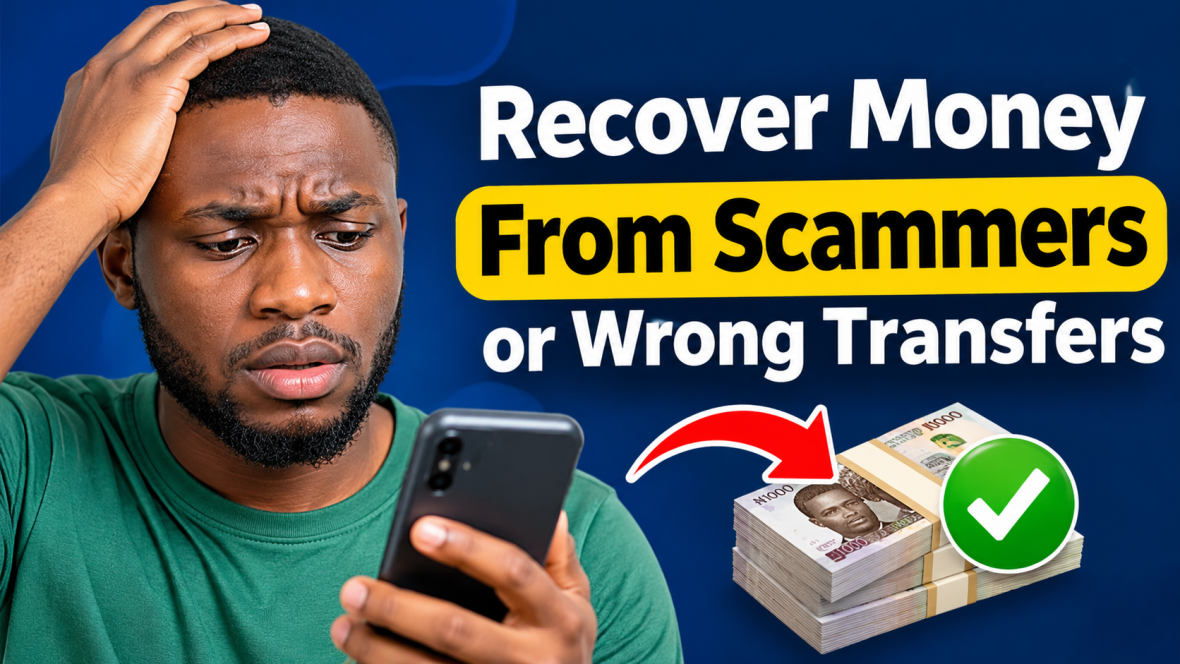
How to Recover Money Sent to the Wrong Account or a Scammer in Nigeria (2026 Guide)
Have you mistakenly transferred money to the wrong bank account? Did you send money to someone who promised to deliver a product or service but disappeared after receiving your payment?
Before you conclude that your money is gone forever, there are important steps you can take to report the transaction and possibly recover your funds.
In Nigeria, thousands of people make mistaken bank transfers or fall victim to online payment scams involving bank accounts, POS transfers, mobile banking applications and social media transactions.
The good news is that you can formally report these incidents to your bank, request a transaction recall, report suspected fraud to law enforcement agencies and escalate unresolved banking complaints to the Central Bank of Nigeria (CBN).
This guide explains how to recover money sent to the wrong account in Nigeria, how to report a scammer’s bank account, how to request a bank transfer reversal and what to do when the recipient refuses to refund your money.
Whether you use Opay, PalmPay, Moniepoint, GTBank, Access Bank, Zenith Bank, UBA, FirstBank or another Nigerian financial institution, the steps below will help you understand what to do.
1. What Should You Do Immediately After Sending Money to the Wrong Account?
The first thing you should do is remain calm and contact your bank or financial institution immediately.
Do not waste time arguing with the recipient or waiting several days before reporting the transaction.
The faster you report the incident, the better the opportunity for the banks involved to investigate and take appropriate action.
Follow these steps:
Step 1: Contact your bank immediately
Call your bank’s official customer care number or visit the nearest branch.
Explain that you mistakenly transferred money to the wrong account and want to initiate a transaction recall.
If you transferred money through a mobile banking application, you can also use its official customer support or complaint channel.
Step 2: Provide your transaction details
Your bank will need information to identify and investigate the transfer.
Prepare the following:
- Your full name.
- Your bank account number.
- The amount transferred.
- Date and time of the transaction.
- Recipient’s account number.
- Recipient’s bank name.
- Transaction reference or session ID.
- Screenshot or receipt of the transfer.
- The correct account details, if available.
Step 3: Submit a formal complaint
Do not rely only on a telephone conversation.
Send a written complaint through your bank’s official email, mobile application or branch.
Clearly request that your bank contact the receiving financial institution and initiate the appropriate recovery procedure.
Step 4: Request a complaint reference number
Ask your bank for a complaint or case reference number.
Keep this number because you may need it when following up or escalating the complaint.
2. Can You Reverse Money Sent to the Wrong Account in Nigeria?
Yes, it is possible to recover money sent to the wrong account, but recovery is not automatic.
The procedure depends on the circumstances surrounding the transaction.
The Central Bank of Nigeria has regulations governing instant electronic funds transfers and dispute resolution.
For example, where a bank itself makes an erroneous transfer contrary to a customer’s instructions, the CBN’s instant payment regulation provides for a written reversal request within 14 working days. Where the funds are available, the receiving institution is required to comply within one business day under that provision.
However, where the customer personally enters the wrong account number, a different procedure applies.
The sending bank can notify the receiving bank, which may place a lien on the disputed amount and seek the beneficiary’s consent for a refund. Where consent is not given, the banks’ internal auditors are expected to mediate under the applicable procedure.
This is why you should explain accurately whether the mistake was yours or the bank’s.
3. How to Recover Money Sent to a Scammer in Nigeria
What if you did not make a mistake but were deliberately deceived?
For example:
- You paid for a phone online, but the seller blocked you.
- You transferred money for a business opportunity that turned out to be fake.
- Someone collected payment for a loan processing service and disappeared.
- You paid for goods through WhatsApp, Facebook or Instagram but never received them.
- Someone impersonated a bank official or government agent and collected your money.
These incidents may constitute financial fraud and should be reported immediately.
Here is what you should do.
Step 1: Contact your bank’s fraud department
Report the transaction as suspected fraud.
Explain what happened, when you transferred the money and the account into which you sent it.
Ask your bank to urgently contact the receiving bank through the appropriate fraud-reporting and interbank channels.
Request an investigation and any available action to restrict or secure the disputed funds.
Step 2: Gather evidence
Evidence is important when reporting financial fraud.
Save the following:
- Bank transfer receipts.
- Screenshots of WhatsApp conversations.
- Facebook or Instagram account details.
- Phone numbers used by the suspected fraudster.
- Website addresses or links used in the transaction.
- The beneficiary’s bank account number.
- Voice messages and other relevant communications.
- Transaction reference numbers.
Do not delete conversations, even if the scammer has blocked you.
Step 3: Report the incident to the EFCC
The Economic and Financial Crimes Commission (EFCC) investigates financial crimes, including various forms of online fraud.
You can report suspected financial fraud through its official website:
Provide a clear account of what happened and attach relevant evidence.
Step 4: Report to the Nigerian Police
You can also report the incident at the nearest police station or through the appropriate police reporting channels.
Provide your bank statement, transaction receipt, communication records and other available evidence.
Step 5: Follow up with your bank
Continue following up with your bank using your complaint reference number.
Ask whether the receiving bank has acknowledged the complaint and whether any funds have been secured.
Remember that reporting a scam does not automatically guarantee a refund. Recovery depends on the evidence, investigation, availability of funds and applicable legal procedures.
4. How to Report a Fraudulent Bank Account in Nigeria
If someone uses a bank account to collect money from unsuspecting Nigerians, you should report the account to the financial institution involved.
Here is how:
- Identify the bank or financial institution where the suspected fraudster maintains the account.
- Contact your own bank and report the transaction as suspected fraud.
- Provide the recipient’s account number, account name, transfer receipt and other available evidence.
- Request that your bank escalate the matter to the receiving institution’s fraud desk.
- Report the incident to the EFCC or Nigerian Police where appropriate.
Do not attempt to hack, threaten or publicly harass the suspected account holder.
Allow the appropriate authorities to investigate and establish the facts.
5. What Happens If the Person Who Received Your Money Refuses to Refund It?
This is one of the most frustrating situations.
Imagine transferring ₦100,000 to the wrong account and discovering that the recipient has received the money but refuses to return it.
You should not assume that there is nothing you can do.
Under the CBN’s instant payment dispute procedure for customer errors, the sending institution can notify the receiving institution, which may place a lien on the disputed amount and seek the beneficiary’s consent for a refund.
If the beneficiary does not consent, the banks’ internal auditors have a mediation role under the regulation.
Where the funds have already been spent or the dispute remains unresolved, you may need to seek assistance from law enforcement agencies or obtain legal advice about further recovery options.
Keep every complaint, response and transaction document.
6. How to Escalate Your Complaint to the Central Bank of Nigeria (CBN)
What if you have reported the matter to your bank several times without getting a satisfactory response?
You may escalate an eligible complaint to the Central Bank of Nigeria.
According to the CBN’s complaints management guidelines, customers must first complain to their financial institution and allow the applicable resolution period, generally two weeks, before escalating an unresolved complaint to the CBN Consumer Protection Department.
You can visit the official CBN complaints page:
You can also send your complaint to:
Email: [email protected]
Your complaint should include:
- Your full name and contact information.
- The name of your financial institution.
- Details of the disputed transaction.
- The amount involved.
- Your complaint history with the bank.
- Evidence of your previous complaint.
- Relevant supporting documents.
Never include your ATM PIN, banking password or OTP in your complaint.
7. Can You Recover Money Sent Through Opay, PalmPay or Moniepoint?
Yes, you can report mistaken transfers and suspected fraudulent transactions involving these financial institutions.
The fact that you used a fintech application rather than a traditional commercial bank does not mean you should abandon your complaint.
If you transferred money through Opay, PalmPay or Moniepoint, follow these steps:
- Open the official application.
- Locate the customer support or complaint section.
- Report the transaction as a mistaken transfer or suspected fraud, depending on what happened.
- Provide your transaction reference and supporting evidence.
- Request an investigation and transaction recovery assistance.
- Keep your complaint reference number and follow up.
If the money was transferred from one institution to another, your sending institution should also be informed so that the appropriate interbank recovery process can begin.
Only use official customer service channels. Avoid phone numbers shared by strangers on social media.
8. What If the Scammer Has Already Withdrawn the Money?
This is a more difficult situation, but you should still report it.
Immediately notify your bank and request a formal fraud investigation.
The receiving institution may be able to investigate the account activity and provide relevant information through the appropriate legal and regulatory channels.
Also report the matter to the EFCC or Police.
If the money has already been withdrawn, recovery may require further investigation, tracing of funds and legal action.
Do not pay anyone who promises to recover your money through secret connections or unofficial banking arrangements.
9. Important Things You Should Never Do When Trying to Recover Your Money
Many victims lose additional money because they fall for recovery scams after the original incident.
Avoid these mistakes:
1. Do not pay a recovery agent upfront.
Be suspicious of people demanding money to unlock, reverse or recover your funds.
2. Never share your OTP.
Your bank’s OTP, PIN and password should remain confidential.
3. Do not install unknown applications.
Fraudsters may send applications or links designed to gain access to your phone or banking information.
4. Do not threaten the suspected recipient.
Use official complaint and legal procedures.
5. Do not delete your evidence.
Keep transaction receipts, messages and other relevant records.
6. Do not delay reporting.
Contact your financial institution as soon as you discover the problem.
10. How to Prevent Sending Money to the Wrong Account
Prevention is better than trying to recover money after a mistake.
Before making your next transfer:
- Confirm the recipient’s account number.
- Check the account name displayed by your banking application.
- Verify the bank name.
- Do not rush when transferring large amounts.
- Send a small test amount when appropriate.
- Avoid transferring money to strangers without verifying their identity.
- Be careful with online sellers who demand urgent payment.
- Never share your banking PIN or OTP with anyone.
A few seconds of verification can save you from losing your hard-earned money.
Frequently Asked Questions (FAQs)
1. Can I recover money sent to the wrong account in Nigeria?
Yes. You can contact your bank, submit a formal complaint and request a transaction recall. Recovery depends on the circumstances, availability of funds and the applicable dispute resolution procedure.
2. How can I reverse a wrong bank transfer in Nigeria?
Contact your bank immediately, provide your transaction details and request a formal transfer recall. Your bank will guide you through the applicable recovery process.
3. Can my bank reverse money sent to a scammer?
Your bank can receive your fraud complaint, investigate and contact the receiving institution through appropriate channels. However, a refund is not guaranteed.
4. How do I report a scammer’s bank account in Nigeria?
Report the incident to your bank’s fraud department and provide the suspected account number, transaction receipt and other evidence. You can also report suspected financial fraud to the EFCC or Police.
5. Can I report a fraudulent bank account to the CBN?
You can escalate unresolved complaints against regulated financial institutions to the CBN after first following the institution’s complaint procedure. The CBN is not a substitute for reporting suspected criminal fraud to law enforcement.
6. What if the person refuses to refund money sent to their account?
Ask your bank to initiate the applicable dispute resolution procedure. If the matter remains unresolved, seek legal advice and consider reporting the incident to law enforcement.
7. Can I recover money sent to a wrong Opay or PalmPay account?
Yes, you can report the transaction through the institution’s official customer support channels and request assistance with the recovery process. The outcome depends on the circumstances.
8. How long does it take to recover money sent to the wrong account?
There is no universal recovery timeline. The applicable CBN dispute procedure contains different timelines depending on whether the error was caused by the bank or the customer. Investigations involving suspected fraud may take longer.
Final Advice
If you have mistakenly transferred money to the wrong account or lost money to an online scammer, do not give up without reporting the incident.
Contact your bank immediately, preserve all available evidence and request a formal investigation.
You can also escalate unresolved banking complaints to the CBN and report suspected financial crimes to the EFCC or Nigerian Police.
Remember: The earlier you report a suspicious or mistaken transaction, the better the opportunity for the relevant institutions to take action.
Share this guide with someone who may need it. It could help someone protect their money or take the right steps after a financial loss.
For more practical guides on banking, loans, grants, financial security and money-making opportunities in Nigeria, visit Okpara.ng.