
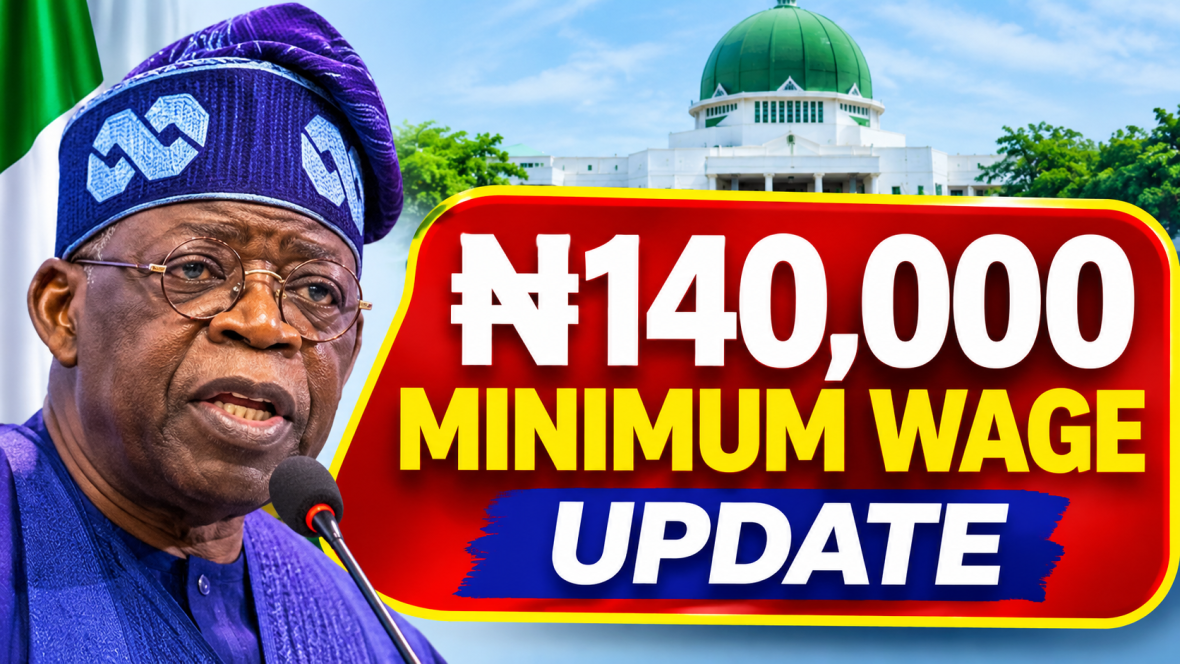
₦140,000 Minimum Wage in Nigeria: FG Approves ₦70,000 Transport Allowance for Workers in 2026
There is growing discussion about a possible increase in Nigeria’s national minimum wage to ₦140,000, following statements attributed to former Nigeria Labour Congress (NLC) President and Senator, Adams Oshiomhole.
The development has generated excitement among Nigerian workers, particularly civil servants who have been hoping for improved salaries amid the rising cost of living.
But is the Federal Government actually increasing the national minimum wage to ₦140,000 from December 2026?
Here is everything Nigerian workers should know.
Is the Federal Government Increasing the Minimum Wage to ₦140,000?
The ₦140,000 minimum wage claim has not been officially established.
What has happened is that the Federal Government and the Nigeria Labour Congress (NLC) reached an agreement on October 27, 2026, to provide a ₦70,000 transport intervention for workers for six months, beginning in November 2026.
This development followed negotiations between the Federal Government and organised labour over workers’ welfare, rising living costs and outstanding agreements.
The confusion surrounding the ₦140,000 figure appears to come from adding the existing ₦70,000 minimum wage to the additional ₦70,000 transport intervention.
However, a transport allowance is not the same as a permanent increase in the national minimum wage.
What Did the Federal Government Agree With the NLC?
Following the October 27, 2026 conciliation meeting, several resolutions were reached between the Federal Government and the Nigeria Labour Congress.
Here are the major agreements:
1. ₦70,000 Transport Intervention for Six Months
The Federal Government agreed to provide a ₦70,000 transport intervention for workers across all levels for six months, commencing in November 2026.
The intervention is intended to help workers cope with rising transportation costs and other economic challenges.
State and local governments were also encouraged to participate in the intervention process.
2. Payment of Outstanding Allowance Arrears
The government approved the payment of outstanding peculiar allowance arrears, effective from May 1, 2026.
The payments are scheduled to commence in November 2026 in three equal monthly instalments.
3. Health Workers to Receive Outstanding Allowances
The government also agreed to redeem 19 months of outstanding allowances owed to health workers within three months, beginning in December 2026.
This is another important development for workers in Nigeria’s health sector.
4. New National Minimum Wage Negotiations
One of the major resolutions was the agreement to establish a Minimum Wage Negotiation Committee.
The committee is expected to commence discussions on a new national minimum wage.
However, the Federal Government and organised labour did not reach an agreement on the effective date for implementing a new minimum wage.
This means Nigerians should not yet regard ₦140,000 as the approved new national minimum wage.
5. Other Workers’ Welfare Issues
The meeting also considered other important issues, including:
- Tax relief for Nigerian workers.
- Hazard allowances for agricultural workers.
- Adjustment of the Consolidated Health Salary Structure (CONHESS).
- Outstanding welfare benefits and other workers’ entitlements.
Some of these matters are still undergoing further consideration and verification.
What Is Nigeria’s Current National Minimum Wage?
Nigeria’s statutory national minimum wage remains ₦70,000 under the National Minimum Wage (Amendment) Act signed in July 2024.
The law provides for a review after three years.
Although discussions about a new minimum wage have commenced, no new ₦140,000 statutory minimum wage has been established as of November 15, 2026.
Will Nigerian Workers Receive ₦140,000 Monthly?
It is important to understand that the ₦70,000 transport intervention is a separate temporary benefit.
It should not automatically be interpreted as a permanent salary increase that changes the national minimum wage to ₦140,000.
Workers should also await official implementation details concerning eligibility, payment arrangements and the participation of state and local governments.
Final Thoughts
The agreement between the Federal Government and organised labour represents an important development in ongoing efforts to improve workers’ welfare.
However, Nigerian workers should distinguish between the approved transport intervention and an actual increase in the national minimum wage.
For now, the existing statutory minimum wage remains ₦70,000, while negotiations on a new minimum wage are expected to continue.
We will continue to monitor developments and provide updates when an official decision on a new national minimum wage is announced.
For more updates on Federal Government programmes, grants, loans, scholarships, job opportunities and empowerment initiatives in Nigeria, visit https://okpara.ng.


